
Which Pre-Employment Aptitude Test Should You Use?
TLDR: A pre-employment aptitude test measures how candidates think, not what they already know. Which one to use depends on the job: cognitive ability for jobs that require figuring things out independently, numerical reasoning for finance and data work, attention to detail for accuracy-first positions, and a general skills assessment when you need a broad baseline.. Here’s how to tell the difference.
Most hiring guides explain what a pre-employment aptitude test measures. Almost none help you choose the right one for a specific job.
Here’s a common situation. You’re filling a finance assistant and a warehouse coordinator at the same time. Both job descriptions mention attention to detail. The candidate pools look similar on paper.
Which test goes with which job? Does either one need an aptitude test, or is a skills test the better call?
The right test can depend on what “failing” looks like in the job. When would a performance improvement plan be needed? Work backwards from there, and it makes the choice clearer.
The Three Categories: Aptitude, Skills, Behavioral Profiles
Before getting into specific tests, it helps to know what each category is built to measure.
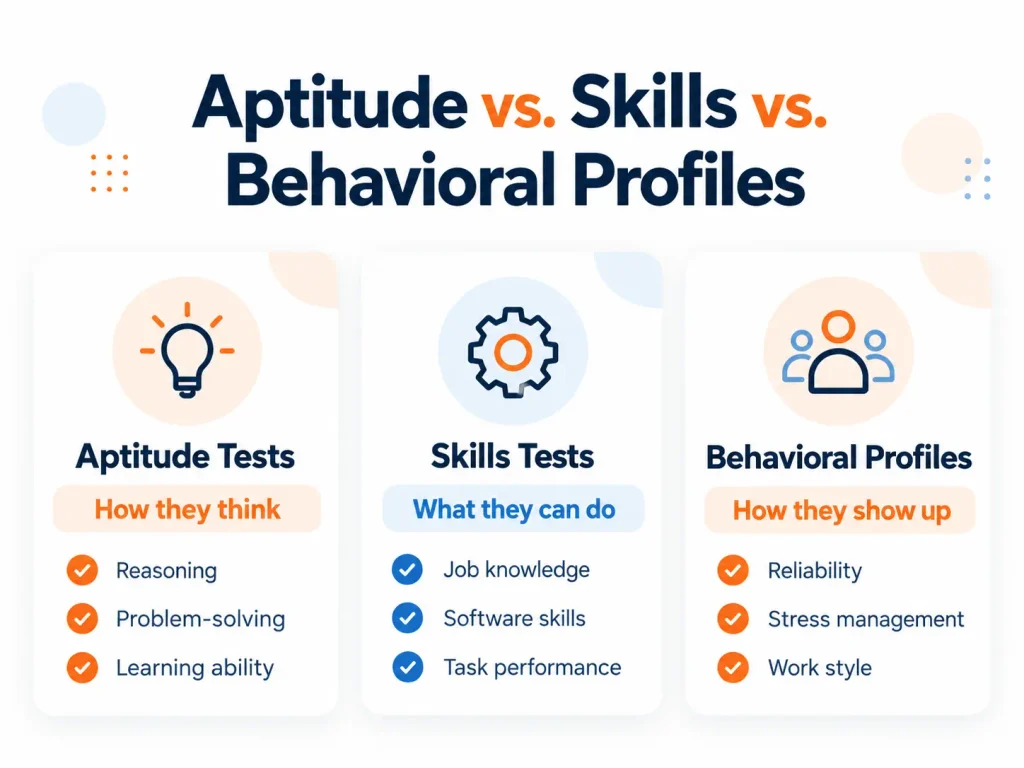
Aptitude tests measure how someone reasons: processing speed, problem-solving, accuracy under time pressure, the ability to handle tasks outside their direct experience. They predict performance on problems the candidate hasn’t seen before.
Skills tests measure what someone can already do: accounting, Excel, grammar, typing. They tell you where a candidate is today.
Behavioral profiles measure how someone shows up at work: reliability, stress management, assertiveness, how they handle conflict and pressure. They tell you what to expect from the person, not just the work.
Most hiring decisions benefit from at least two of these. Some need all three. The rest of this post works through each.
Aptitude Tests: How Someone Thinks
Aptitude tests belong in jobs where thinking through new situations is part of the work. Three types cover many hiring situations.
Cognitive Ability Tests: When Figuring Things Out Is the Job
A cognitive ability test measures how quickly and accurately someone processes new information, spots patterns across different contexts, applies logic to unfamiliar problems, and holds up under time pressure.
Studies found cognitive ability to be one of the strongest predictors of job performance, particularly in jobs with a real learning component. For small and mid-sized businesses where employees have to figure things out without much support, that’s a real need.
Right fit: office managers, team leads, operations coordinators, customer service supervisors, generalist admins. Jobs where thinking through a new situation on the fly matters more than any specific prior knowledge.
For a practical guide to fitting this into a process that already has other steps, Using a cognitive aptitude test covers the specifics.
| Jobs with a lot of on-the-fly decision making benefit from using a cognitive aptitude test. These applicants can just make better decisions, faster. Ken Crowell, Founder, EmployTest |
Numerical Reasoning: When Numbers Are the Actual Job
A math skills test and a numerical reasoning aptitude test look similar from the outside. They measure different things.
A math test checks whether someone can calculate. Numerical reasoning checks whether they can use numbers to reach a sound conclusion. A payroll processor job with heavy math requires a math skills test when hiring. A finance assistant who produces reports with flawed conclusions needs numerical reasoning. The symptom is the same: bad numbers. The cause, and the test that would have caught it, are different.
The math test tells you what they know. Numerical reasoning tells you what they can do with it under real work conditions.
Right fit: finance, accounting clerks, payroll processors, inventory coordinators, and data analytics jobs that go beyond basic input. These candidates score more predictively on numerical reasoning than on a general cognitive measure, because the test mirrors what the work actually requires.
Attention to Detail: When Accuracy Is the Whole Job
Attention to detail tests measure three things: the ability to catch errors, compare information accurately, and hold that accuracy when working quickly. Timed, structured, unambiguous.
Right fit: billing coordinators, compliance roles, quality control, admin jobs with heavy records or document processing. Jobs where the core task is consistent and errors have real downstream consequences.
Cognitive ability and attention to detail are the two most commonly confused aptitude tests. Accuracy-first jobs require attention to detail. Judgment-first jobs need cognitive ability. Running the wrong one gives you data that answers the wrong question about the candidate.
If you’re deciding between the two for a specific job, check out this article.
Skills Assessments: What Someone Can Do Today
Skills tests answer a different question from aptitude tests. A skills test measures what someone already knows how to do, verified under real conditions, not self-reported on a resume.
Use a skills test when the job has a clear, measurable core competency you need to verify before hiring.
An Accounting Knowledge Test for a bookkeeper or AP coordinator. An Excel Assessment for roles that depend on spreadsheets. A Typing Speed and Data Entry Test for admin and processing roles.
A general skills assessment covers practical job knowledge across several areas: reading comprehension, grammar, math, and related working foundations. The question it answers is about practical readiness for common everyday tasks.
Behavioral Profiles: How Someone Shows Up
A behavioral profile measures what neither a skills test nor an aptitude test can: how a candidate actually behaves at work.
Reliability, stress management, assertiveness, flexibility, how they handle conflict, whether they take initiative or wait for direction. These traits predict whether someone will be a low-maintenance hire or a constant management problem, regardless of how well they tested on skills or aptitude.
For customer-facing jobs specifically, the Customer Service Aptitude Test measures four traits tied directly to that work: respectfulness, service orientation, stress management, and conscientiousness. It shows what a skills test won’t: whether someone is naturally patient when a customer is frustrated.
When to Pair Tests
One test answers one question. Most jobs have more than one.
There are 3 things a test can tell you about a candidate: what they can do, how they reason, and how they behave at work. Most hiring decisions benefit from at least two of those. Some need all three.
Skills plus a behavioral profile is a solid combination. An accounting skills test tells you whether a candidate knows the work. A personality profile test tells you how they show up: their reliability, stress management, assertiveness, flexibility, and whether their drive and team orientation actually fit the job.
For customer-facing jobs, the Customer Service Profile adds what a skills test can’t show: whether someone is naturally patient, stays calm when a customer is frustrated, and recovers quickly when things go sideways. Pair it with a written communication test for jobs where email or chat is the primary channel.
The starting point is still the same question: what does a bad hire in this job actually look like? Match the test setup to the answer.
For a full look at what’s available by job and skill type, the full test list covers everything EmployTest has.
Most hiring mistakes are preventable. A candidate who interviews well but tests poorly is still the wrong hire. A candidate who tests well on skills but has the wrong behavioral profile is still the wrong hire. The tests exist to surface that before the offer goes out, not after the first performance review.