The Banking Skills Test gives you a clear look at how bank applicants handle money math and fine details, plus how they treat customers, before hiring.
A teller who keys the wrong account number or miscounts a deposit creates rework for the whole branch. This banking skills test checks those skills, along with the work habits that keep a cash drawer balanced.
It fits teller, member service, new accounts, and branch customer service positions at banks and credit unions.
EmployTest helps you scale hiring at your own pace with pay-per-test block pricing and no long-term contracts.









The Bureau of Labor Statistics lists six important qualities for tellers. Detail orientation, integrity, math, and customer service are four of them.
Most of those are hard to judge in a 30-minute interview. Every applicant says they’re careful with money.
BLS also projects about 26,800 teller openings each year, mostly to replace people who move on. That’s a lot of interviews for a branch manager.
A bank assessment test gives every applicant the same questions. You compare them on equal footing and spend interview time on your strongest matches.

The test covers seven areas. Two are skill sections with right or wrong answers. The other five look at work behavior.

Teller work asks for two things at once. O*NET data shows 82% of tellers rate being exact as extremely important, and 96% report constant contact with other people.
This bank teller assessment test covers both sides. The Attention to Detail and Math Skills sections each have 20 questions.
Your report shows how many questions each candidate attempted and answered correctly, next to the average for all test takers.
For more on accuracy screening, read why attention to detail testing belongs in hiring.

A bank personality test answers what an interview rarely settles: how this person acts on a normal shift when a customer is upset or the drawer comes up short.
The five behavior scales cover helping, reliability, stress, teamwork, and trust. Each one lists expected job behaviors in plain language, such as staying calm during conflict with customers and coworkers.
Trustworthiness carries extra weight in banking. The report flags it as most important for cash handling jobs and anyone who sees confidential information.
See key personality traits for success to learn how behavioral testing pairs with skills testing.

Each report opens with an overall score rated Caution, Moderate, or High. Then every area gets its own breakdown:
Scale Scores and Ratings: A score for all seven areas, with expected job behaviors.
Skill Level Detail: Questions attempted, correct, and incorrect for the two skill sections.
Strength of Responses: Answer strength on each behavior scale, from Strong to Weak.
Time per Question: Average seconds spent on each scale, so you can spot rushing.
Management Strategies: What each candidate needs from a manager, useful for judging team fit.
Interview Guide with Scored Follow-Up Questions: Questions for lower-scoring areas, with a 1 to 7 rating scale.
Research summarized by SIOP ranked structured interviews as the strongest single predictor of job performance among the methods reviewed. The Interview Guide makes that structure easy to follow.
When a candidate scores lower on a scale, the report gives a follow-up question for it. On Team Player, for example, you’d ask how they’d handle a teammate whose poor work drags down the group.
Rate each answer from 1 to 7, then average the ratings. Every interviewer scores the same way, and the results sit next to references and work history when you make the call.

Use this pre-employment banking test for front-line jobs where cash and customer data cross the counter. Common job positions include:
It also works as a financial services skills test for check cashing stores and other counters that handle cash all day. Pair it with a structured interview for the final decision on each applicant.

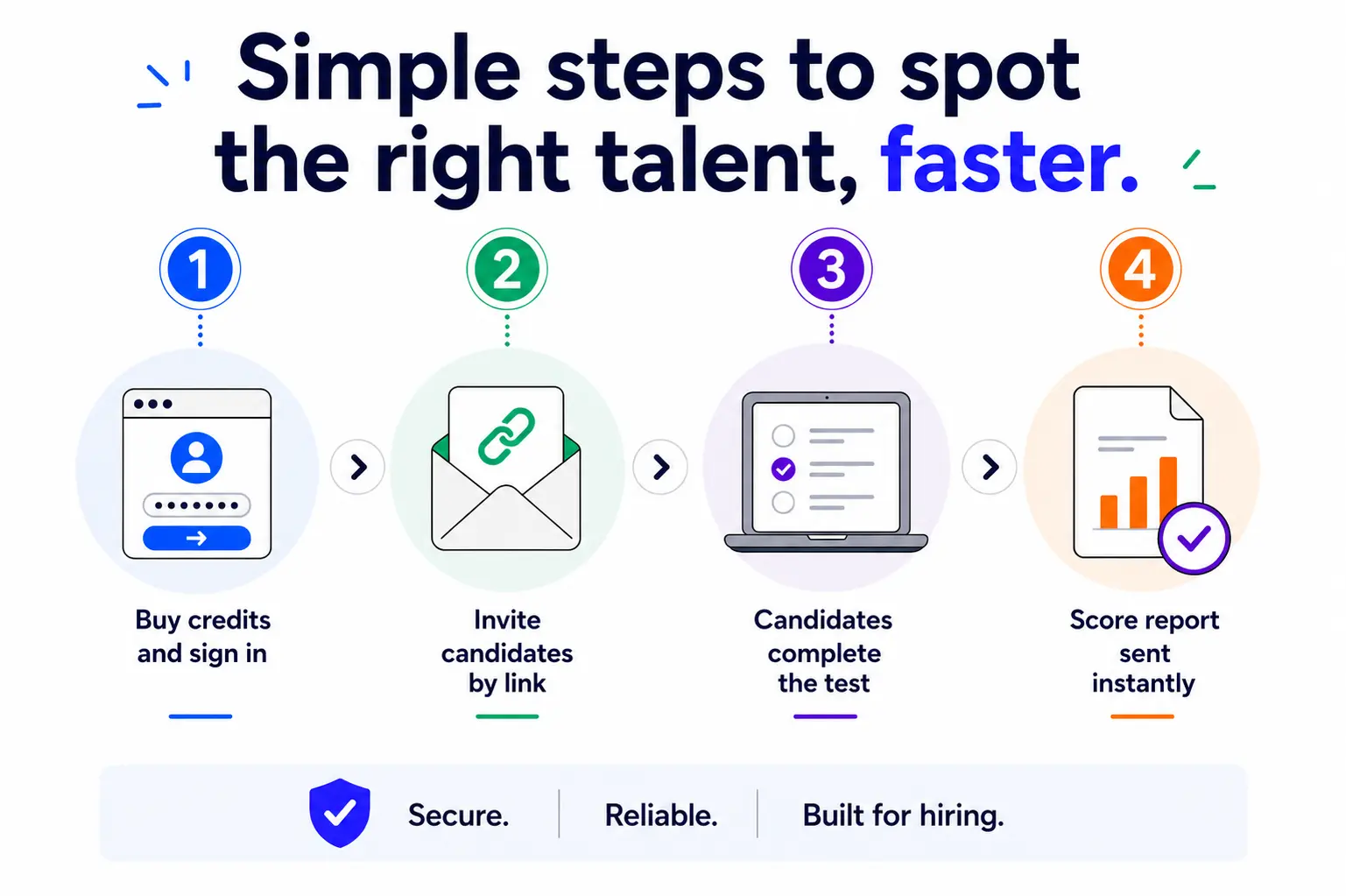
Getting started takes four steps:



Seven areas: Attention to Detail, Math Skills, Helping Disposition, Reliability, Stress Management, Team Player, and Trustworthiness. The first two are skill sections scored right or wrong. The other five describe work behavior.
It was built for that kind of work. Teller jobs depend on accurate counting and patient service, and the test checks both. It also fits member service, new accounts, and personal banker positions.
Each rating shows how a candidate compares to others who took the test. High ratings point to strengths. A Caution rating tells you which area to dig into during the interview.
Start with the Interview Guide with Scored Follow-Up Questions. Ask the suggested questions, rate each answer from 1 to 7, and weigh the results alongside references and work history.
The report shows the average time spent per question on each scale. Very fast times paired with a low math score can mean the candidate was guessing.
Pricing is simple and flexible as your needs change. Each test completed uses one test credit. (See pricing for credits)
Yes, just visit Try for Free to provide your information and we’ll send a free sample of the test you request.


