
When to Use an Attention to Detail Test vs a Cognitive Aptitude Test
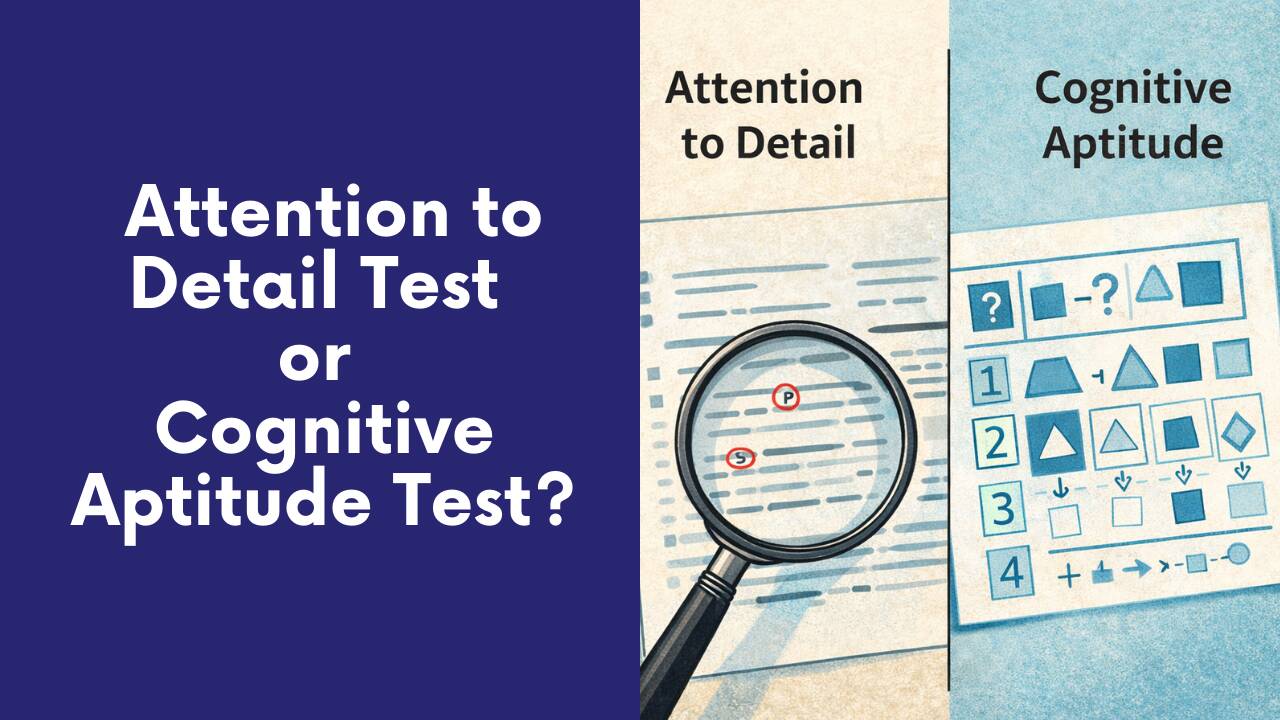
Not all “thinking” tests measure the same thing.
It makes sense at first to lump attention to detail tests and cognitive aptitude tests into the same bucket. They shouldn’t be.
They answer two completely different hiring questions.
If you use the wrong one, you don’t get a bad result; you just don’t get the signal you actually need.
Here’s how to choose.
Use an Attention to Detail Test When Accuracy Is the Risk
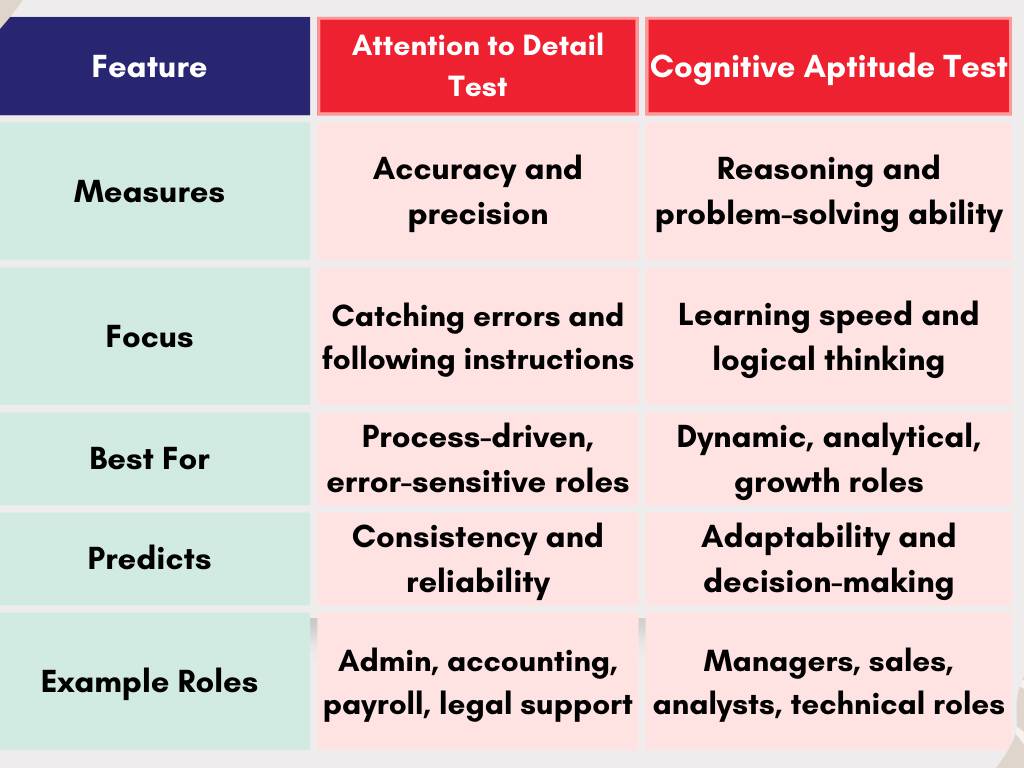
An attention to detail test measures precision.
It shows you whether a candidate can:
- Spot inconsistencies
- Catch small errors
- Compare data accurately
- Follow instructions exactly
- Maintain focus on specific work tasks
This test answers one simple question:
Will this person catch mistakes before they become expensive?
Use it when the role is process-driven and error-sensitive.
For example:
- Administrative assistants
- Accounting and bookkeeping roles
- Payroll and billing staff
- Legal assistants
- Compliance positions
In these jobs, small errors snowball. One missed number. One overlooked clause. One incorrect entry.
If accuracy is part of the job description, it should be part of your screening process.
An attention to detail assessment gives you direct evidence of precision before day one.
Use a Cognitive Aptitude Test When Reasoning Drives Performance
A cognitive aptitude test measures reasoning ability.
It evaluates how well someone can:
- Solve unfamiliar problems
- Recognize patterns
- Process new information quickly
- Apply logic under time pressure
- Learn new systems
This test answers a different question:
How quickly and effectively can this person think through new challenges?
Use it when the role requires adaptability, decision-making, or problem-solving.
Examples:
- Managers and supervisors
- Sales professionals
- Operations roles
- Analysts
- Technical hires
- Project managers
If the environment changes often and the role isn’t purely task-based, reasoning ability becomes a strong predictor of performance.
A cognitive aptitude test helps you evaluate learning capacity and problem-solving skills, not just resume claims.
The Core Difference
Here’s the cleanest way to think about it:
Attention to detail = execution accuracy.
Cognitive aptitude = reasoning capacity.
One measures how carefully someone performs known tasks. The other measures how effectively they handle new ones.
A candidate can think fast but miss small errors.
Another can be extremely accurate but slower with abstract reasoning.
Neither is “better.” It depends on the job.
When You Should Use Both
Some roles demand both precision and reasoning.
An accounting supervisor must analyze financial trends (reasoning) and review reports for errors (accuracy).
A sales manager needs strategic thinking (reasoning) and contract review precision (detail).
When the role blends complexity with risk, combining assessments gives you a clearer picture.
Hiring becomes more predictable when you measure both capacity and consistency.
Make the Test Match the Job
The right assessment doesn’t complicate hiring. It clarifies it. Define the skill. Measure the skill. Hire with confidence.
If you’re ready to stop relying on resume claims, check out the assessments today.