
How to Screen Accounting Staff Without Relying on Resumes
TLDR: To screen accounting staff, stop guessing with resumes and interviews. To hire better accounting staff, screen for real skills (accuracy, attention to detail, problem-solving skills) with a short test before the interview.
Every resume says the same thing. Here’s how to know who can actually do the job.
Every accounting candidate’s resume looks the same.
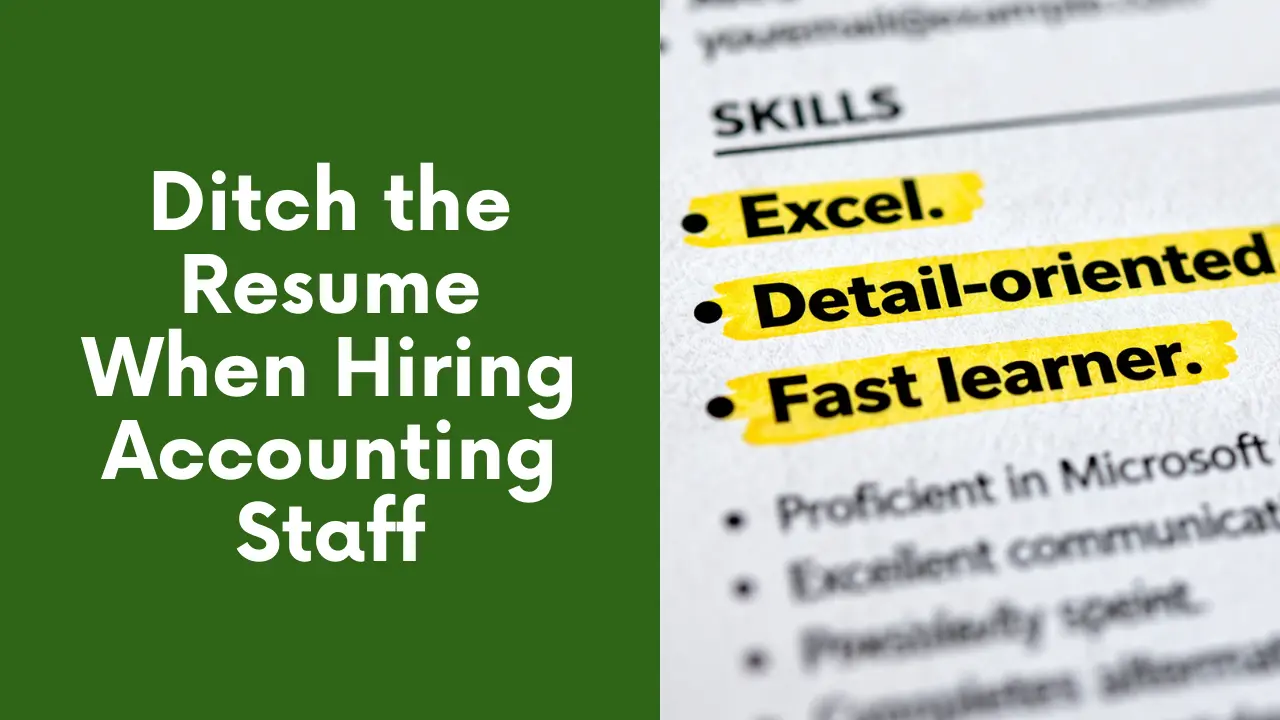
Excel. Detail-oriented. Fast learner.
You have read those three words so many times they have stopped meaning anything.
Here is the problem. A CNBC poll said 60% of candidates claim mastery of skills they barely use. Excel is one of the most common.
And yet most hiring decisions at this level still come down to who interviewed well.
Then week two hits. And you learn the hard way.
What people think works
The resume gets them in the door. The interview confirms they seem reliable.
References say something generic. You make the hire.
This feels like a process. It is not really a process.
It is a series of gut checks dressed up as hiring.
Why it fails
Resumes at this level are nearly identical.
Everyone has used Excel. Nobody puts “slow” or “makes errors.”
Interviews are even worse here.
Accounting staff are not hired for their communication skills.
They are hired to prepare financial reports, assist in budget management, reconcile accounts, and process invoices, without making a mess.
None of that shows up in a conversation.
You cannot interview someone into being accurate.
And when it goes wrong, it is expensive.
The U.S. Department of Labor estimates a bad hire costs at least 30% of that employee’s first-year earnings. For a $40,000 clerk, that is $12,000 gone.
And that is before you factor in the errors they made while they were there.
What actually predicts performance
For accounting clerks and AP/AR staff, the skills that matter are simple.
But they are concrete. And they are testable.
- Data entry speed and accuracy under realistic conditions
- Spotting errors in a ledger or invoice set
- Basic math and reconciliation without a safety net
- Navigating accounting software, not just claiming they have used it
These are the things that separate a good hire from a problem hire.
None of them show up on a resume.
All can be screened before the first interview.
What screening looks like in practice
Keep it short. Keep it relevant.
A 15 to 20-minute test is enough to tell you what you need to know.
- An error-spotting exercise in numerical strings and telephone numbers.
- A basic Excel task that mirrors something they would do on day one
- A short software check to see if applicants can use QuickBooks or a similar program.
You are not just testing accounting knowledge. You are testing for the basics that the job actually requires.
Where it fits in your hiring process
Test first. Interview the people who pass.
This sounds obvious. Most teams still do it the other way. They interview five people, then think about testing.
Flip it.
You will interview fewer people. The ones you do talk to will already have shown they can do the basics.
Instead of guessing if they can handle the work, you are figuring out if you want to work with them.
That is a much better use of everyone’s time.
What changes when you hire this way
Fewer week-two surprises.
Shorter ramp-up because you already know they can handle the basics.
Less back-and-forth when a hire does not work out.
And if you do high-volume or repeat hiring for these roles, it scales.
Same test. Every candidate. Every time.
How to Screen Accounting Staff the Right Way: Start here
Pick one role you hire regularly. Write down the two or three skills that actually drive performance in that role.
Test those skills before the first interview.
See what changes.
EmployTest has assessments built specifically for accounting staff roles.
Check out the accounting staff assessments here.