
Should You Share Test Scores With Candidates? What to Say Instead
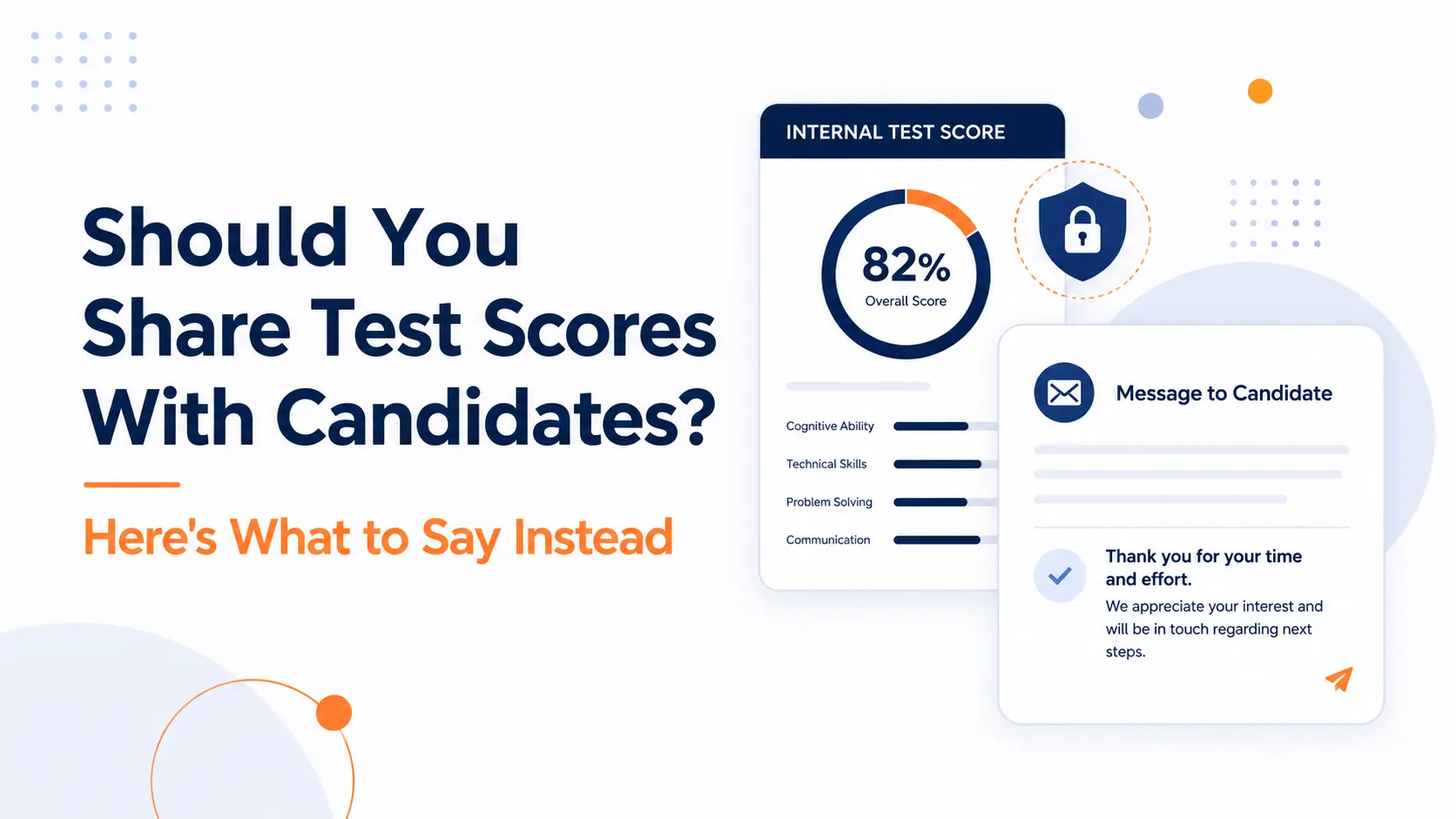
TLDR: Sharing test scores with candidates creates more confusion than it solves. A score is just one part of a decision that may also include interviews, experience and references, but once a candidate sees the number, they think it explains everything. Keep scores with the hiring team, and give candidates a real, timely update instead.
Sharing test scores with candidates is one of the most common requests hiring teams hear after a pre-hire test, and it’s also one of the easiest to handle badly. A candidate finishes the test, a few days pass, and an email lands asking how they did.
The instinct to just tell them feels kind. It also tends to backfire.
Why the Request Feels Reasonable
The candidate finished the test a few days ago. They’re nervous, they want closure, and a number feels like the fastest way to get it. So they ask. And some hiring teams, wanting to seem transparent, are tempted to just tell them.
Don’t. Or at least, not the way you’re picturing it.
Four Reasons to Keep the Number In-House
A score means little without a comparison group. Skills assessments are built to rank applicants against each other, and that comparison is where the number gets its value. A 74 might place someone in the top quarter of applicants for one role and the bottom half for another. Without that context, the number invites guesswork.
It reshapes how the whole decision gets read. Once a candidate has that number, it becomes the lens for everything else. An applicant who scored well but interviewed poorly, or who has gaps in their work history, starts to feel like the outcome didn’t add up. The score becomes the story, even when it was always just a part of it.
It puts your team in a defensive position. A visible number turns “we went another direction” into “explain this number to me.” Hiring managers end up re-hashing a decision built from interview performance, references, and overall fit. That’s a conversation with no winners.
It protects the assessment for the next applicant. Test questions and scoring methods hold up over time because the details stay out of general circulation. Sharing specific results with one candidate, even informally, chips away at that over time.
Research backs this up in an interesting way. A meta-analysis of applicant reactions found that explaining the hiring process to candidates modestly improved how fair they felt it was.
But a separate study found something almost backwards: rejected candidates who got detailed performance feedback actually reported feeling worse than the ones who got none at all.
Explaining how the process works helps. Handing over the specifics of why someone lost usually doesn’t.
What to Say When a Candidate Asks
Have the language ready before the question shows up, so nobody’s caught off guard
- “It’s our practice to keep individual assessment results within the hiring team.” This reads as steady rather than evasive, since it applies to every candidate the same way, not just the one asking.
- “Thank you for your interest and for the time you put into the process. We’ve decided to move forward with another candidate.” Handles the vast majority of rejections, testing included, without inviting a debate.
- If they push back, let them vent for a second before redirecting: “I know this is a hard one to hear, but we want every new hire to be a fit for both them, and us. Candidates almost always land better when they feel heard first.
And if you want a bigger precedent to point to: even the federal government’s own hiring process keeps individual assessment results out of candidate communications, by policy, for the same reason. Consistency is the whole point.
Give Them Something Better Than a Number
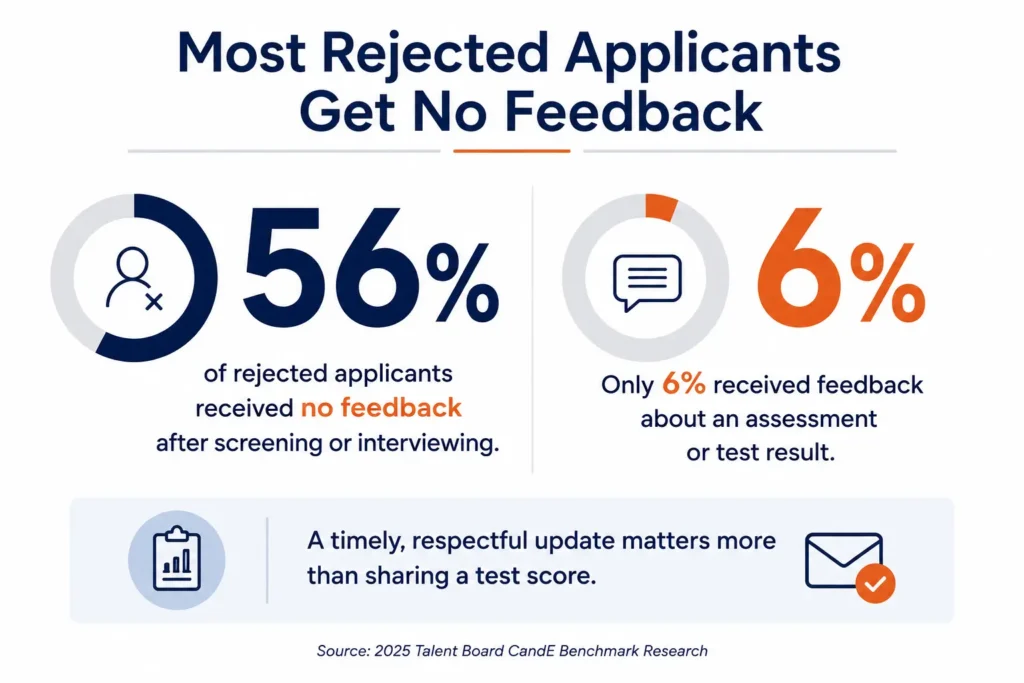
Silence is the weaker alternative here, and it’s the default most companies fall into. Talent Board’s candidate experience research found that most rejected applicants got zero feedback after screening or interviewing. That’s a low bar, and it’s an easy one to clear.
A short, timely note goes a long way: thank them for their time, confirm the role’s been filled, offer genuine encouragement if there’s any to give.
The same research found candidates who got specific, constructive feedback at the interview stage were far more likely to refer others and consider reapplying later. None of that requires the score. It just requires treating the candidate like someone who gave you real time and deserves a real reply.
Where the Score Actually Belongs
The score matters, and it belongs on your side of the table. Use it to compare candidates against each other and to sharpen the questions you ask in the interview room.
A low score is worth a second look before you rule someone out, especially if the rest of the application is strong. A high score deserves a real interview.
Remember, use test scores the way they’re meant to be used, and let the candidate walk away with something better than a number: a straight answer, delivered with respect.
If you’re weighing which tests would actually strengthen your process, take a look at the full test library or book a quick consult and we’ll help you figure out what fits.
Sources
- U.S. Office of Personnel Management. “Assessment Results FAQs.” USA Hire Applicant Resource Center. support-usahire.opm.gov/hc/en-us/articles/45424525942675
- SHRM. “How You Reject a Job Candidate Defines Your Recruitment Strategy.” shrm.org/topics-tools/news/talent-acquisition/how-reject-job-candidate-defines-recruitment-strategy
- Truxillo, D. M., Bodner, T. E., Bertolino, M., Bauer, T. N., & Yonce, C. A. (2009). “Effects of Explanations on Applicant Reactions: A Meta-Analytic Review.” International Journal of Selection and Assessment, 17(4). onlinelibrary.wiley.com/doi/abs/10.1111/j.1468-2389.2009.00478.x
- Schinkel, S., van Dierendonck, D., van Vianen, A., & Ryan, A. M. (2011). “Applicant Reactions to Rejection: Feedback, Fairness and Attributional Style Effects.” Journal of Personnel Psychology, 10(4). researchgate.net/publication/232521851
- ERE Media. “Latest Findings on Giving Feedback to Candidates Show Missed Opportunities” (Talent Board CandE research). ere.net/articles/latest-findings-on-giving-feedback-to-candidates-show-missed-opportunities

