
How to Test AI Skills When Hiring for Office Roles
TLDR: Every job candidate says they’re great with AI. Almost no one checks if that’s true before hiring. This article shows what real AI skills look like in an admin, office manager, or receptionist position, why interviews miss it, and how to add a quick AI skills test to your hiring process.
You’ve seen it by now. Every resume says the same thing: comfortable with AI, skilled with AI tools, AI-savvy. It means nothing anymore. Nobody checks if it’s true and an AI skills test would catch it in five minutes.
An office manager candidate sends you a sample schedule built with AI. It looks decent. The real question is what she asked the AI for. A vague prompt like “build me a weekly schedule” gets a generic schedule back, one that ignores who covers lunch, whose shifts can’t overlap, who requested Friday off.
A specific prompt that spells out those constraints gets something built for the actual job. You can’t tell which kind of prompt she used just by looking at the result.
Two admins both used AI to draft the same client follow-up email. One typed “write a follow-up email.” One told it to keep it under five sentences and sound firm, not apologetic, since the client already said no once. Read both emails. One of them will make you wince.
That’s how hard it is to separate a real skill from a claimed one. If it took a full study to answer that question, you’re not catching it by skimming a resume for thirty seconds.
What do AI skills look like on the job?
So what does real AI skill look like?
Start with the prompt. A clear, specific request gets a good answer the first try. A vague one means three rewrites and wasted time.
Then there’s order. A project plan or a report needs steps that make sense, and AI makes that worse when someone doesn’t already think that way on their own.
Someone also needs to catch mistakes. AI tools screw up charts and numbers all the time, and somebody has to notice instead of nodding along.
Checking the reasoning counts too. AI sometimes hands you an answer that sounds right but isn’t. Someone has to catch that before it goes out the door.
And somewhere in a messy pile of numbers, a real pattern needs spotting. That’s what separates someone who actually gets the tool from someone who’s just clicking buttons.
None of this shows on a resume . A clean spreadsheet or a well written email looks good either way, whether AI helped build it or not. What a work sample can’t show you is whether the person behind it can write a sharp prompt, order information correctly, or catch it when the AI gets something wrong.
EmployTest built a test that covers these skills in one sitting. You get an actual score, not a guess. Worth a look before building something from scratch: Artificial Intelligence Test for Applicants.
Fitting it into a hiring process that already works
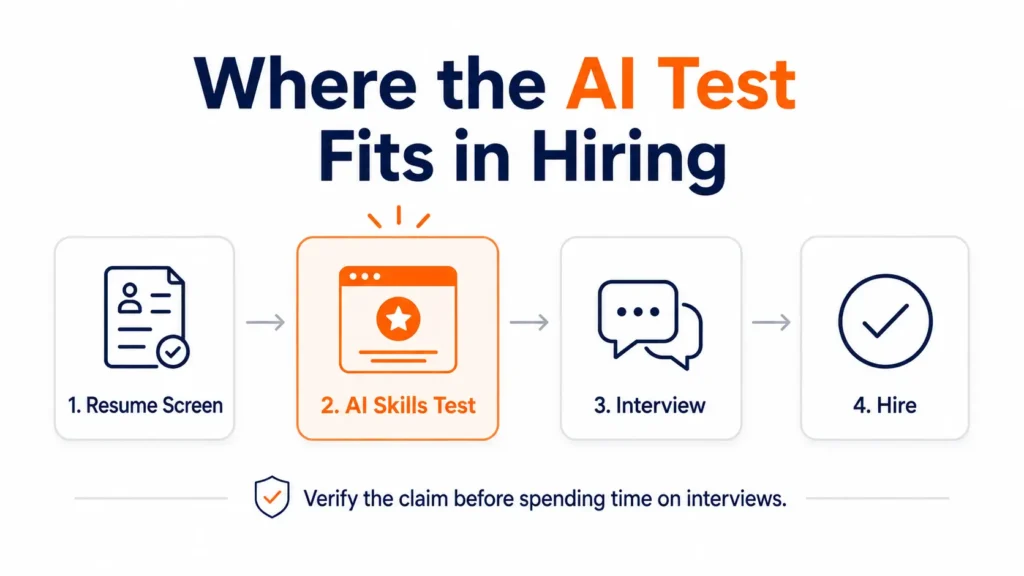
You don’t need to change your whole hiring process for this. Add the test right after you screen resumes, before you set up interviews. Candidates who can’t back up their claims drop out early, and you save an hour of interview time.
Match the test to the job. A receptionist and an office manager use AI differently day to day, so the same score means something different for each.
If a resume talks up AI skills and the test score doesn’t match, bring it up in the interview. That’s a fair question.
Round it out with tests you already trust
This test works even better next to a few others. An Attention to Detail Test catches the same thing you’re checking for: whether someone notices when AI gets something wrong.
A Cognitive Ability Test checks if someone can judge AI’s reasoning, not just copy the output.
And Excel is its own trap. A candidate who knows Excel can explain a formula. One who let AI build it usually can’t, and an Excel Assessment Test catches that in minutes. Add any of these to the mix and you’ll know a lot more than whether someone’s comfortable with a chatbot.
Trusting a resume used to be enough. That’s getting expensive fast. The hiring managers catching this early are the ones checking for it now, instead of finding out six months in that the “AI-savvy” hire needs help with everything. EmployTest runs on block-based credit packs with no annual commitment, so adding one more test to the lineup doesn’t mean signing a new deal.
For a longer look at how AI is reshaping which office roles look different a year from now, this piece on jobs AI will replace and create is worth a read.

