The Accounts Payable Test for Applicants shows you who can handle invoices and get the daily math right on vendor payments.
A resume can list three years of AP work. It cannot tell you whether that person catches a duplicate invoice or codes an expense to the wrong account.
This accounts payable test gives you that answer before you hire.
EmployTest is built for low to medium hiring needs, with flexible pricing and no expensive annual contracts.
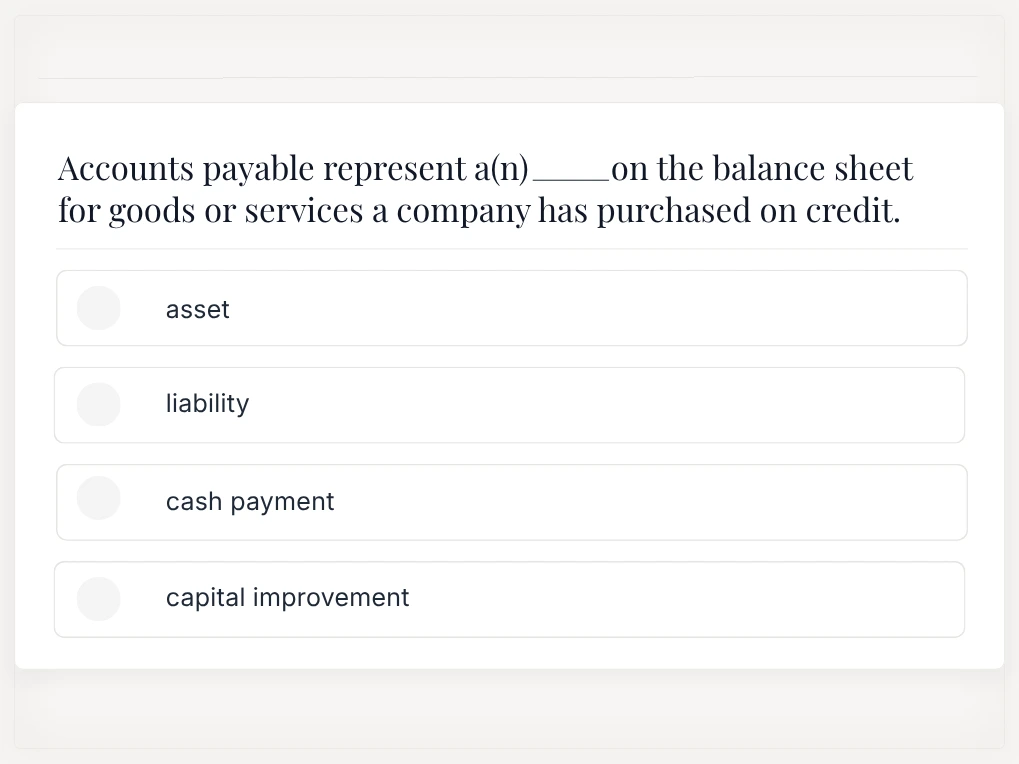








This accounts payable assessment is scored across six topic areas. Every question maps to one of them, so you can see where a candidate is strong and where they slip.
Business Documents is the section that mirrors real desk work. Candidates read an actual invoice and pull a ship date, work out the tax, or figure an early payment discount.
It measures accounts payable knowledge itself. That understanding carries over to whatever system your team runs.

Accounts payable is where money leaves your company. Small errors get costly fast.
The Association of Certified Fraud Examiners found that asset misappropriation appeared in 90% of the fraud cases it studied, with billing schemes among the biggest risks by both frequency and loss. The median scheme ran about 12 months before anyone caught it.
A strong AP hire is your first check on that. They question an odd invoice instead of paying it.
Hiring volume stays steady too. The Bureau of Labor Statistics projects roughly 144,100 openings each year in bookkeeping and accounting support work, so most teams refill these seats often.

The test has 34 questions. Each one is tagged by topic and by difficulty, so nothing is guesswork when you read the results.
Difficulty splits three ways:
A basic question might ask what an accrued liability is. An intermediate question asks the candidate to work out a discount percentage on an invoice.
The two advanced questions ask them to read assets and liabilities together, which is where weaker applicants tend to stall. Time spent is tracked on every question, so you also see who moved quickly and who sat stuck.
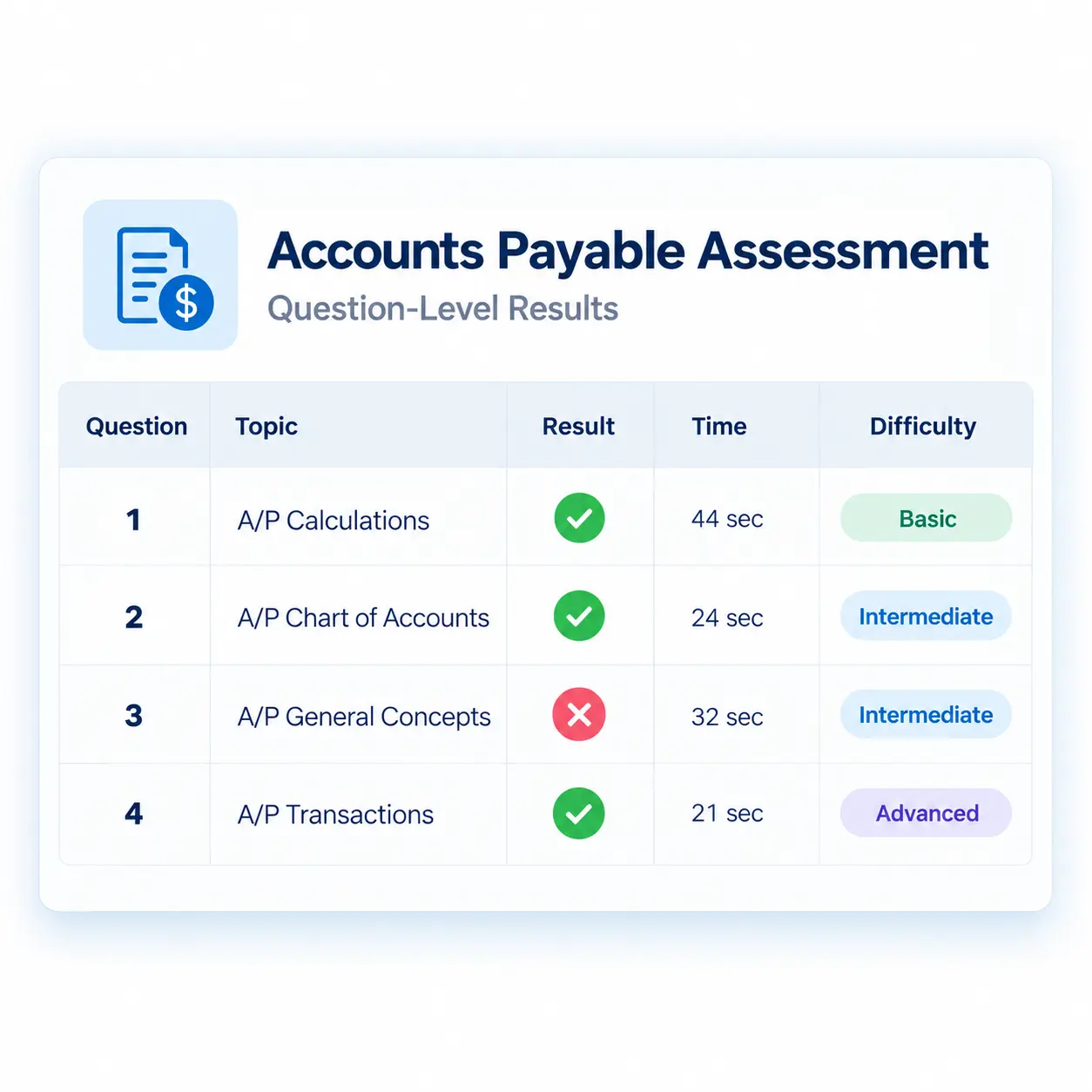
The score report reaches your inbox the moment the candidate finishes. Here is what you get.
Send the test before you book interview time. You walk in already knowing where the gaps sit.
Say a candidate scored 50% on A/P Transactions and 100% on General Concepts. That earns a targeted follow-up. Ask them to walk you through how they would record a payment.
The topic scores hand you that structure for free.
For more on building an interview around evidence, see these interview techniques for hiring managers.

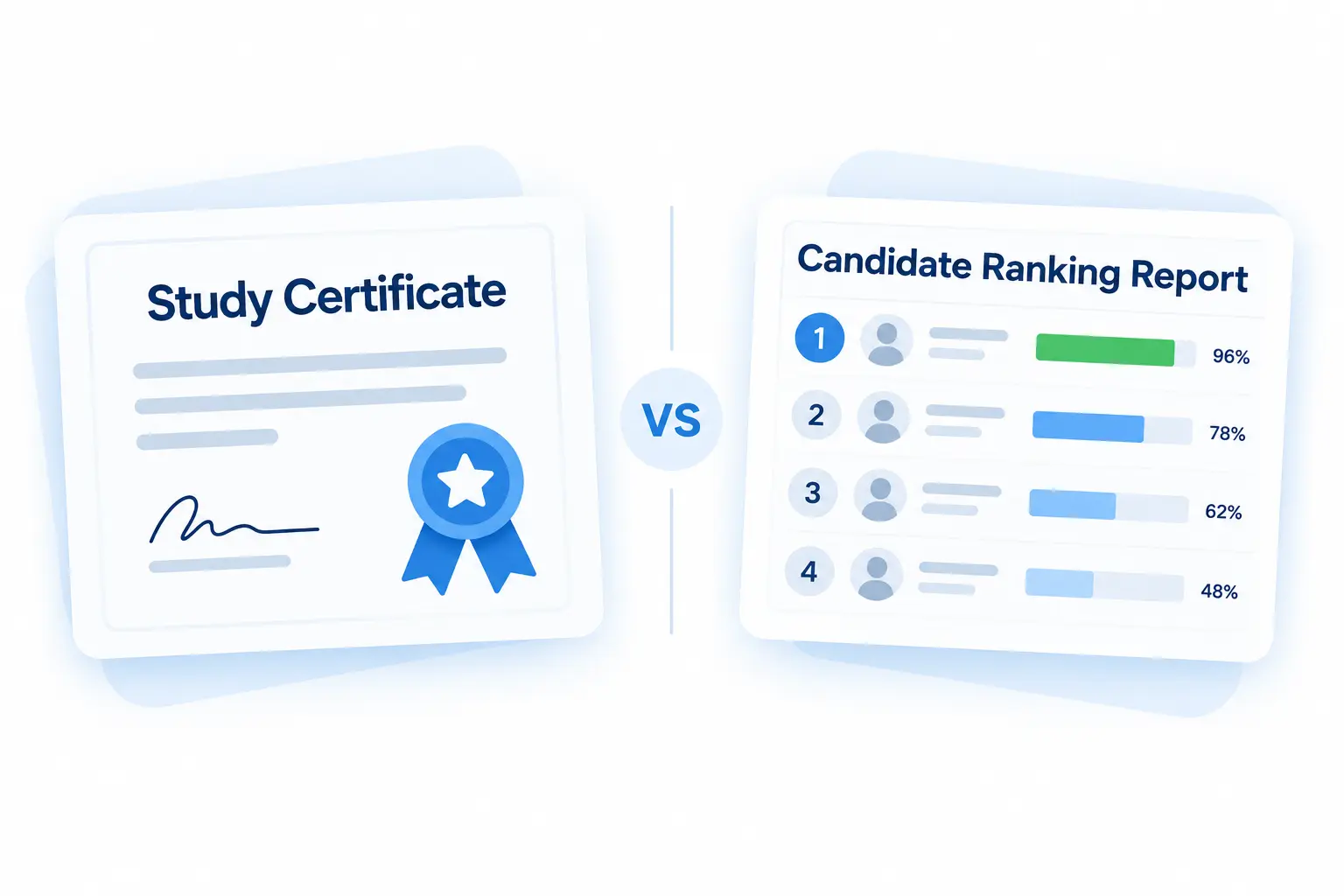
Candidates often search for accounts payable certification practice tests. Those are study tools, built to prep one person for a credential exam.
This test does a different job. You send it, the candidate takes it once, and you get a scored report you can hold up next to every other applicant.
A scored assessment gives you something a credential cannot: the same measurement on every person you are considering, taken on the topics your job actually needs.
Both have their place. Only one lets you rank the shortlist.
Use this test when the job involves coding invoices and keeping the payables ledger accurate. That covers:
Hiring for more than one accounting job at once? This guide on picking the right accounting assessment for each job covers what to send and when.
SHRM research found that 78% of HR professionals said assessments improved the quality of their hires, and 79% rated assessment scores as important as traditional hiring criteria or more so.




The test has 34 scored questions across six topic areas. They are split into 13 basic, 19 intermediate, and 2 advanced questions, so you see how a candidate holds up as the material gets harder.
No. It measures accounts payable knowledge itself: calculations, transactions, the chart of accounts, and reading business documents. Those skills carry over to any system your team uses. Add an Excel Skills Test if the job also needs spreadsheet work.
Send it after your resume screen and before you spend interview time. Most hiring teams test the whole shortlist at once, then use the topic scores to shape the questions they ask each finalist.
Yes. Every candidate answers the same 34 questions and gets scored the same way. You can line up overall percentages and topic scores side by side to see who is genuinely stronger on the work you are hiring for.
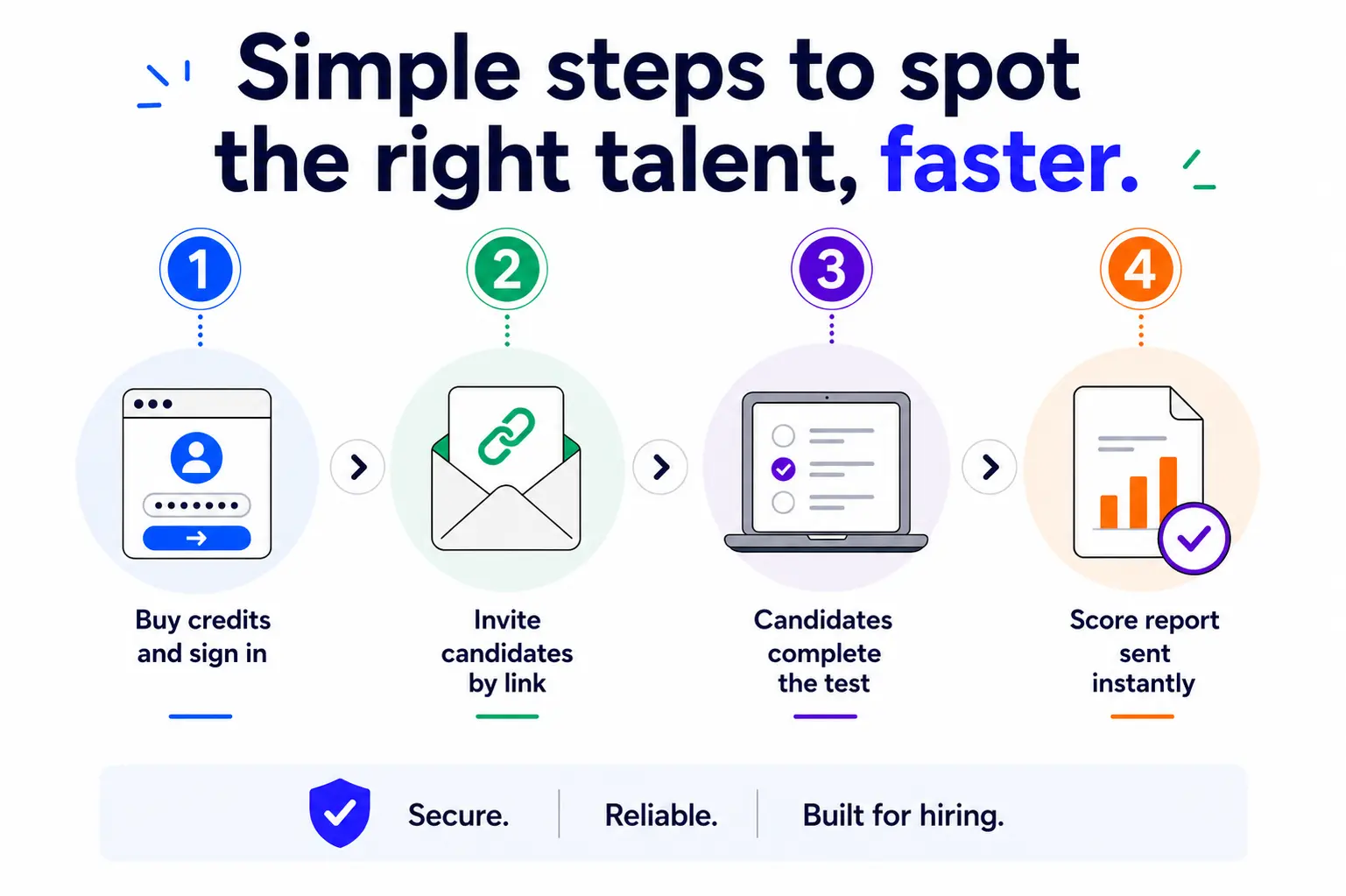
Pricing is simple and flexible as your needs change. Each test completed uses one test credit. (See pricing for credits)
Yes, just visit Try for Free to provide your information and we’ll send a free sample of the test you request.


