
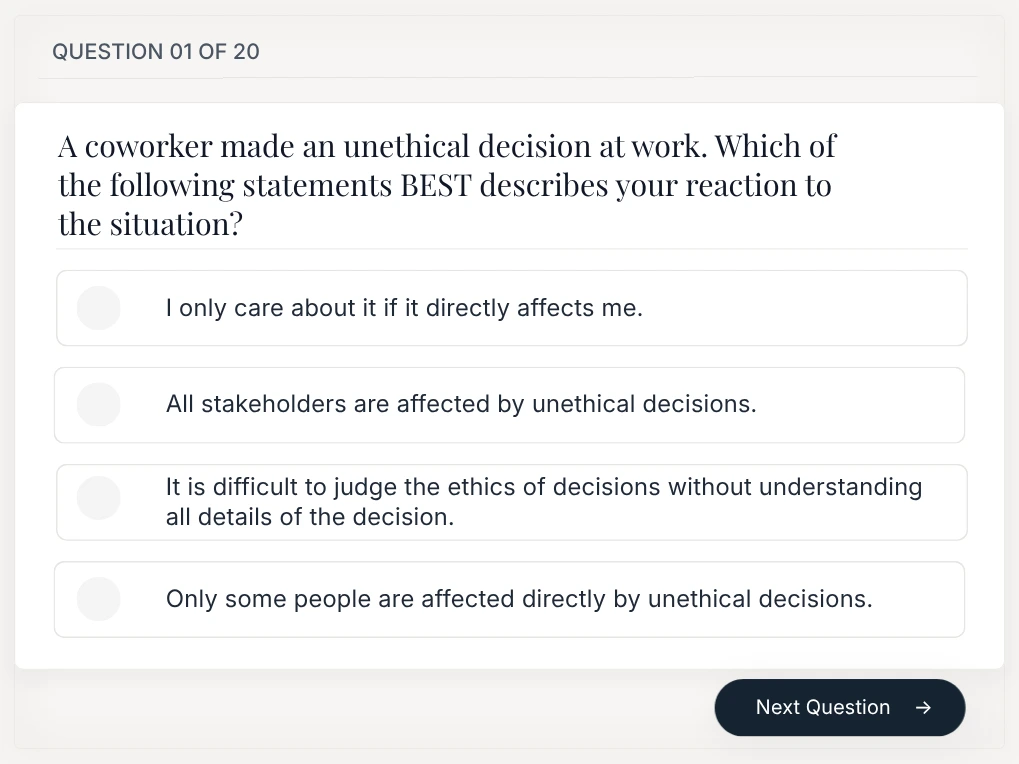


What jobs is this test best suited for?
This test fits any entry-level role that depends on consistency, teamwork, and following procedure: cashiers, fulfillment staff, warehouse workers, restaurant crew, receptionists, and administrative support.
The Behavioral Test for Entry-Level Jobs is built to catch what a resume never shows. A resume lists past jobs. It won’t tell you if someone shows up on time, follows directions, or pitches in when a shift gets rough.
This Workplace Success Profile scores four traits that drive day-to-day performance in retail, warehouse, hospitality, and support roles: dependability, rule-following, teamwork, and work ethic. Send the test link, the candidate finishes it online, and you get a plain-language score report the moment they submit.
EmployTest offers flexible per-test pricing for low to medium hiring volume, with no annual license or expensive contracts required.
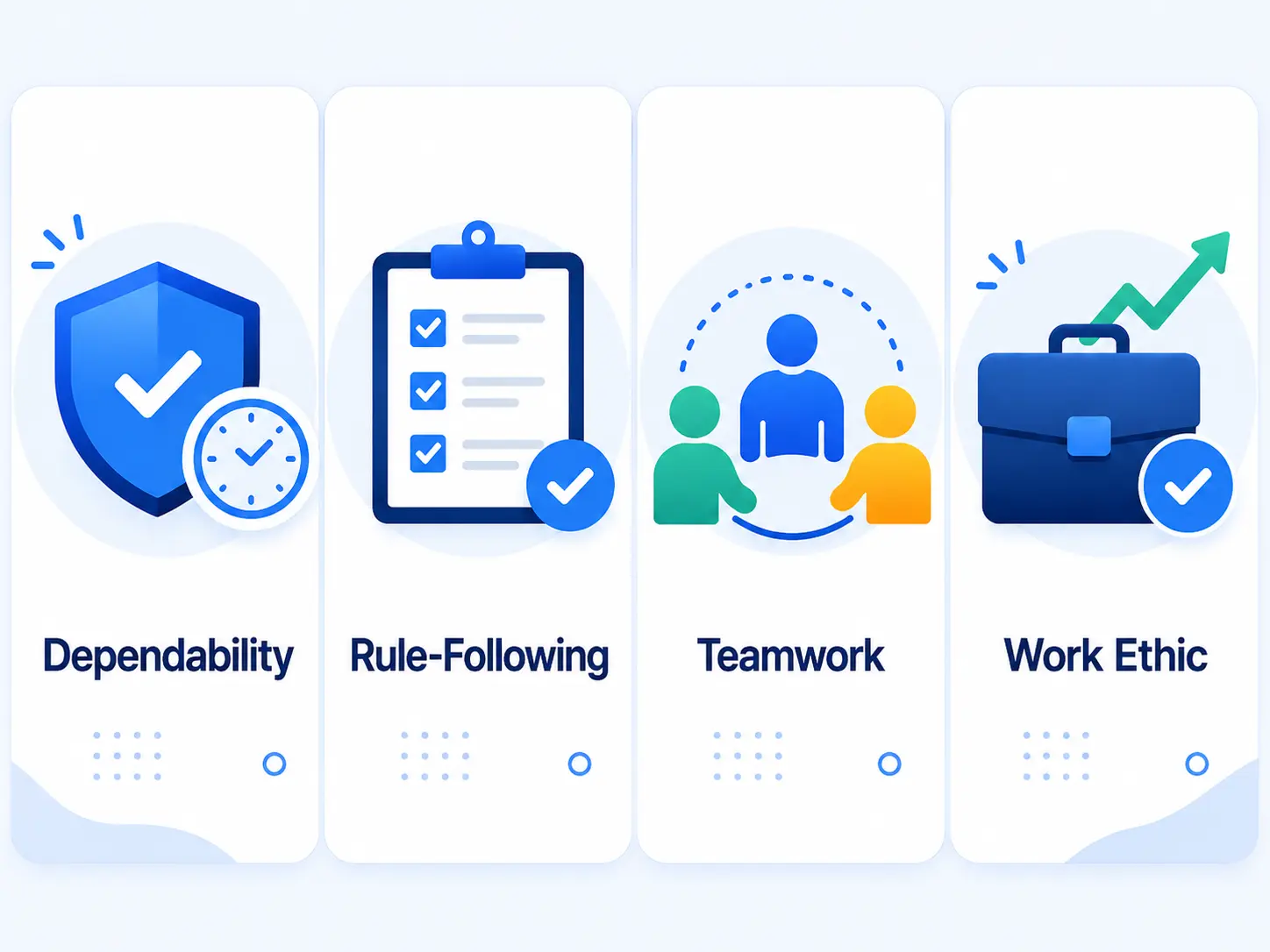
Anyone can put “reliable” and “hard-working” on an application. This entry-level employee screening test checks whether that holds up. It scores four behavioral traits tied to performance in high-turnover roles:
Dependability. Shows up on time and finishes assigned work with few errors.
Rule-Following. Sticks to procedure and acts with integrity, even without a supervisor watching.
Teamwork. Works well with coworkers and supervisors and keeps friction low on the floor.
Work Ethic. Pushes through tasks, takes initiative, and finishes what they start.
Behavioral traits aren’t guesswork to employers. NACE’s Job Outlook 2026 Spring Update survey found that teamwork and work ethic rank among the attributes employers value most in candidates, alongside problem-solving and communication.
The pattern holds up in peer-reviewed workplace research too: traits like dependability and rule-following fall under what psychologists call conscientiousness, and conscientiousness consistently correlates with job performance across industries.
A behavioral test for entry-level jobs gives you a standardized way to measure these traits before the offer goes out, instead of guessing from a 30-minute interview.

Entry-level roles turn over fast. Retail, hospitality, and warehouse floors post some of the highest quit rates of any sector, according to the Bureau of Labor Statistics’ Job Openings and Labor Turnover Survey.
Every departure means posting the job again, training a replacement, and running short-staffed in the meantime. A workplace success profile screens for the traits tied to sticking around and doing the work well, before you extend an offer.
Roles where every missed shift creates a ripple effect across the team benefit most: one dependable hire can steady a whole shift.

You’ll get a full score report the moment the candidate finishes. The report opens with an overall assessment score, shown as a percentile from 1 to 99 and sorted into one of three bands: Substantial Strength (above the 50th percentile), Adequate Strength (21st–50th percentile), or Not a Strength (1st–20th percentile).
Below that, each of the four traits gets its own percentile score and a plain-language write-up of what that score typically looks like on the job, so you know what you’re getting before you extend an offer.
This reliability test for job applicants’ scores is compared against a normative population, not a fixed pass line. For a full breakdown of how percentile scores work, and why they beat raw percentages for comparing candidates, see percentile vs percentage: key difference when hiring employees.
Once you’re comfortable reading the report, comparing five or ten candidates side by side takes minutes instead of hours.
This behavioral assessment for high-turnover roles fits any entry-level job where reliability and attitude affect the bottom line:
Administrative and front-desk support – steady follow-through on repetitive tasks
Warehouse and fulfillment – pace-driven work with real safety stakes
Hospitality and food service – teamwork under pressure, shift after shift
Customer service – patience and rule-following under stress
If you’re building a full screening process, read more on using behavioral assessments for hiring to see where this test fits alongside interviews and skills tests.

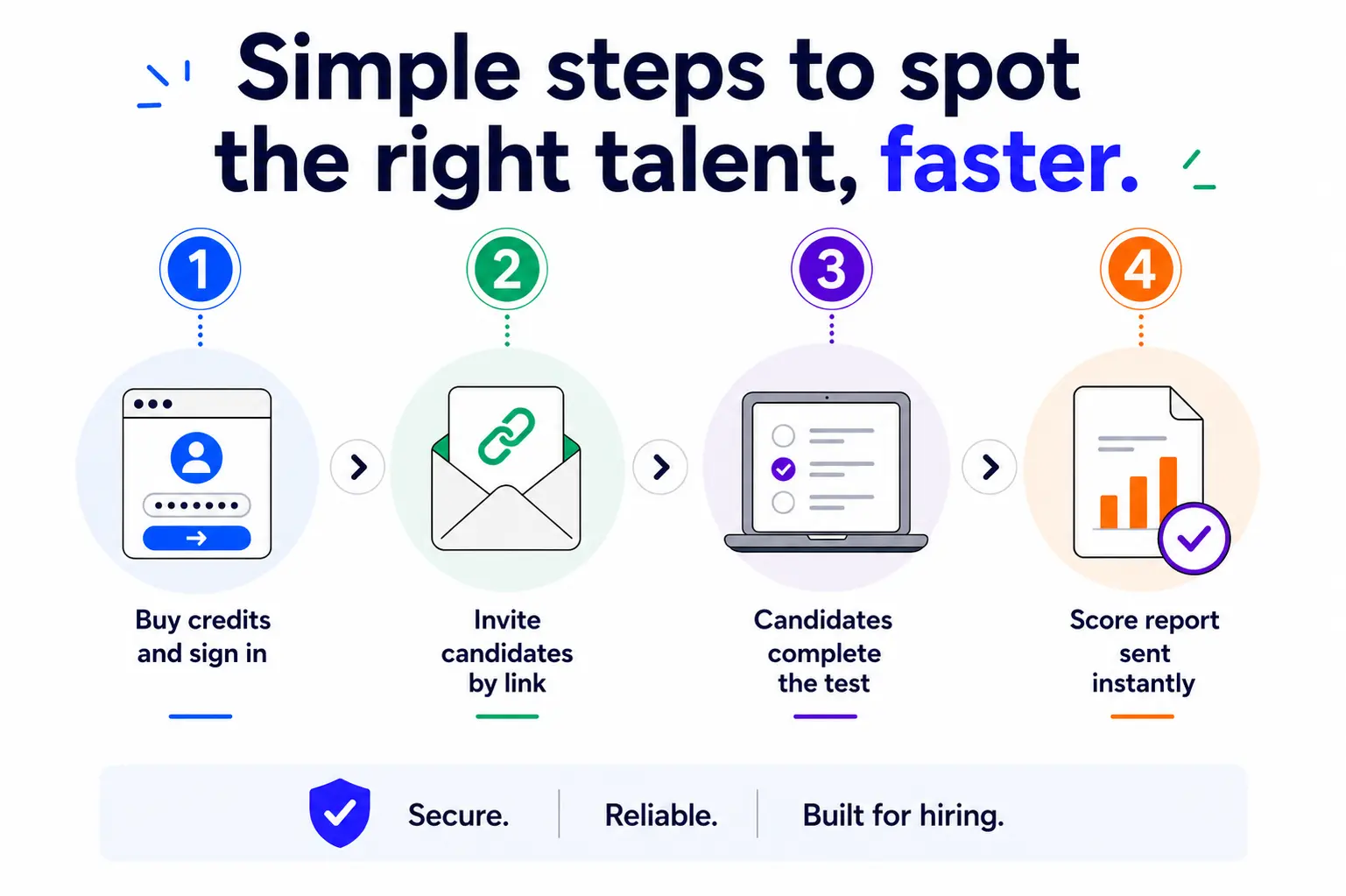
Getting started takes minutes:
Select a test with skills that are desired and I can narrow down my list of interviews.”
What jobs is this test best suited for?
This test fits any entry-level role that depends on consistency, teamwork, and following procedure: cashiers, fulfillment staff, warehouse workers, restaurant crew, receptionists, and administrative support.
Is this a general personality test?
Not quite. This behavioral assessment focuses on how a person is likely to act in workplace situations that affect daily performance, rather than categorizing personality traits in general.
How is this different from a skills test?
This test measures behavior and work traits – dependability, rule-following, teamwork, and work ethic – not technical ability. Pair it with a skills-based test like the Basic Skills Test for a fuller picture of a candidate.
How do I interpret a "Not a Strength" score on the report?
A low score on one trait isn’t an automatic disqualifier. Treat it as a flag to explore further. Ask about it directly in the interview and weigh it against the rest of the candidate’s profile.
Can I use this test alongside other assessments?
Yes. Many hiring teams pair this behavioral test with a skills or cognitive test to get a fuller picture of a candidate before making an offer.
How much does this cost?
Pricing is simple and flexible as your needs change. Each test completed uses one test credit. (See pricing for credits)
Can I get a free sample before I purchase?
Yes, just visit Try for Free to provide your information and we’ll send a free sample of the test you request.


