The Service Advisor Profile Test for applicants shows how a candidate is likely to act at your service counter before hiring.
It’s built for the person who greets customers, writes up the repair order, explains what the technician found, and calls when the car is ready.
Use this automotive service advisor assessment to compare applicants on five traits, from Attention to Detail to Reliability. Each score report gives you an overall rating plus follow-up interview questions for any trait worth a closer look.
EmployTest is ideal for occasional or ongoing hiring, with flexible pricing and no long-term contracts.









The score report makes it easy to identify top applicants. It shows their strengths and potential red flags, including:
Most customers never meet the technician. They meet the service advisor.
In J.D. Power’s Customer Service Index Study, the service advisor ranked as the second biggest driver of dealer service satisfaction. The same study found customers were greeted right away only about half the time.
Resumes list past jobs, and most interviews happen on a calm afternoon. Neither one shows how an applicant treats an upset customer whose repair came in over the estimate.
A behavioral assessment gives every applicant the same questions, so your comparison is fair. Here’s what poor customer service costs a business.

Each scale ties to a real part of the job.
These match the work styles O*NET lists for customer service jobs, including dependability, cooperation, empathy, and social orientation.

Plenty of managers search for a service advisor aptitude test. This profile gives you a skill measure and a behavior measure in one report.
Attention to Detail is the skill scale. The report shows how many items the candidate answered correctly and the average time spent on each one.
The other four scales come from a behavioral assessment. Each one shows the strength of the candidate’s responses, from Strong to Weak, plus the behaviors you can expect on the job.
New to behavior-based screening? This guide on key personality traits for success is a good place to start.

The Reliability scale looks at a trait researchers call conscientiousness. It covers self-discipline, persistence, organization, and responsibility.
A review of more than 100 years of research found conscientiousness is the personality trait most tied to strong job performance across jobs. The authors suggest employers measure it when making hiring decisions.
For a service advisor, it looks like calling a customer back when promised and checking the estimate twice before it goes out.
An applicant in the Caution range on Reliability deserves a careful follow-up question in the interview.

Every completed test produces one score report with these parts:
The report also lists start time, finish time, and total testing time.

Use the Service Advisor Profile Test for any job where an employee recommends services to customers. That includes:
If your new hire will stand between the customer and the technician, this assessment fits. Filling a general service desk instead? It also works as a customer service personality test for any job built on helping people and following through.

The Interview Guide turns the report into a short, structured interview.
Say an applicant scores lower on Flexibility. The guide gives you a question such as, “Would you describe yourself as pretty much set in your ways?”
You rate each answer from 1 to 7, from poor performer to excellent performer. For high-scoring traits, you can ask your own question and rate it the same way.
Add up the ratings and divide by the number of questions to get an average rating. Weigh it with references and work history before hiring.

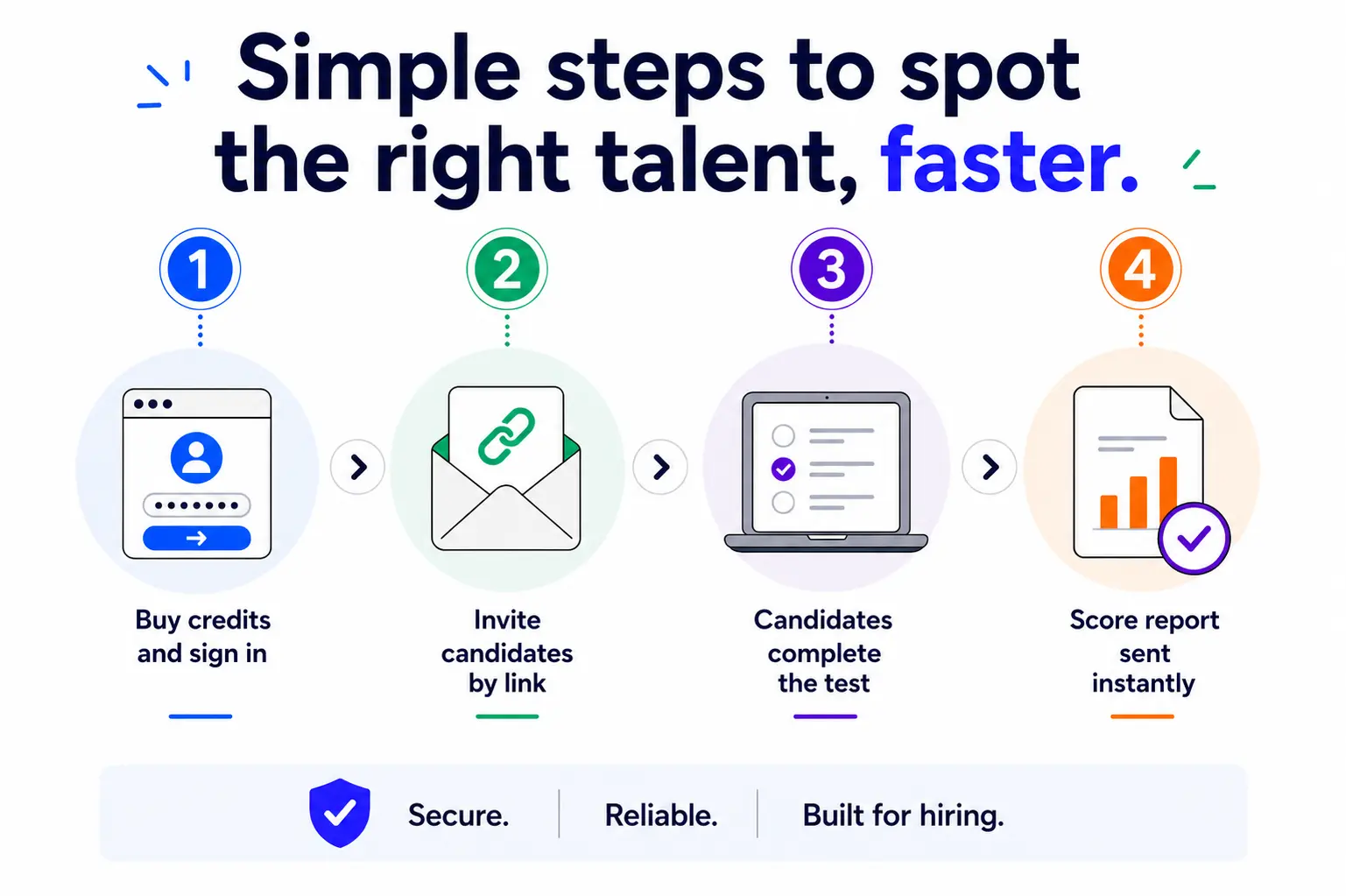
Getting started takes four steps:
Want a fuller picture of each applicant? Add one of these:




Any job where an employee recommends services to customers. Common examples are dealership service advisors, repair shop counter staff, and service coordinators at HVAC and electrical companies.
It’s both. Attention to Detail is a skill scale scored on correct answers. Flexibility, Helping Disposition, Interpersonal Skills, and Reliability are behavioral scales based on how the candidate responds.
Each rating shows how strongly a candidate showed a trait compared with other test takers. The overall rating is the average across all five scales. Treat a Caution rating as a topic to explore in the interview.
Ask the questions listed for any trait that needs a closer look, then rate each answer on the 1 to 7 scale. The report shows you how to total the ratings and find an average, so you can compare applicants the same way.
Use the results as one part of the picture. The score report itself recommends combining them with a structured interview, references, and work history. The final decision always stays with you.
Pricing is simple and flexible as your needs change. Each test completed uses one test credit. (See pricing for credits)
Yes, just visit Try for Free to provide your information and we’ll send a free sample of the test you request.


