
How to Screen Front Desk Receptionists Before Hiring
TLDR: Screening front desk receptionists before you hire helps you spot strong communicators, confirm typing and organizational skills, catch customer service gaps, and avoid the cost of a bad hire. This guide covers what to test for, common screening mistakes, and how to build testing into your process.
Why This Hire Matters
Screening front desk receptionists before you hire protects your business from a costly mismatch at the front door. Your reception staff is the first voice a customer hears and the first face a visitor sees.
Before a client ever meets your sales team or a patient ever sees a doctor, the receptionist has already shaped their opinion of your business.
That makes this hire more important than the job title suggests.
Small businesses often treat the front desk as an easy position to fill. The job posting goes up, a handful of resumes come in, and the person with the friendliest interview gets the offer. That approach skips the one thing that actually predicts success on the job: real evidence of skill.
What a Bad Receptionist Hire Really Costs
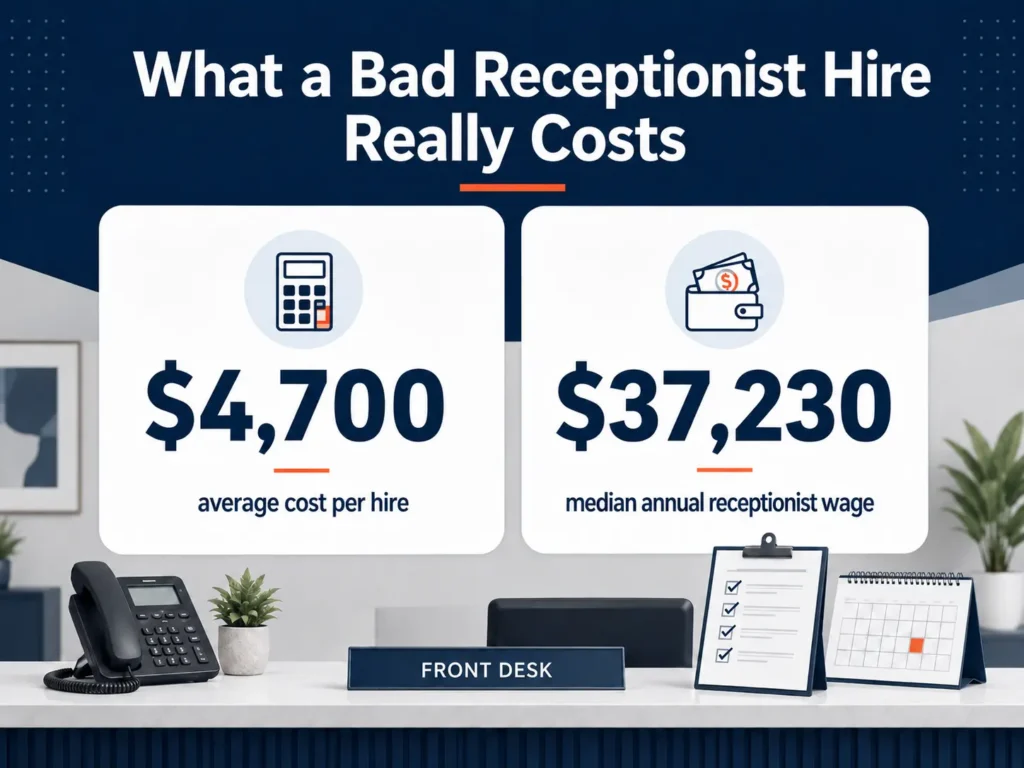
Replacing a bad hire adds up fast. SHRM puts the average cost per hire at nearly $4,700 across industries, covering job postings, interview time, and onboarding. The Bureau of Labor Statistics reports the median receptionist wage at $17.90 an hour, or about $37,230 a year.
Those numbers only cover the direct costs.
A new receptionist who struggles with the phone system, mishandles a visitor, or falls behind on scheduling creates a ripple effect. Callers wait longer. Messages get lost. Your team spends time correcting mistakes instead of focusing on their own work.
None of that shows up on an invoice, but it shows up in how smoothly your office runs.
Common Screening Mistakes That Let Weak Candidates Through
Most hiring mistakes happen before the interview even starts. A resume tells you where someone worked, not how well they perform. An unstructured interview tells you how someone talks about their skills, not whether they have them.
Relying only on these two steps means you are hiring on impression rather than ability. A candidate can sound confident and organized in an interview and still struggle once they are managing a ringing phone, a waiting visitor, and three open tasks at once.
What to Test For
Typing and data entry speed matter most for front desk staff. Receptionists log messages, update schedules, and enter visitor information constantly. The Typing Speed and Data Entry Tests confirm a candidate can keep pace without slowing everyone else down.
Customer service aptitude comes next. A candidate might type fast and still struggle to stay patient with a frustrated visitor or an irritated caller. The Customer Service Aptitude Test surfaces that gap before it becomes a problem on your floor.
Attention to detail rounds out the practical skills. Front desks run on accuracy: comparing visitor logs, following instructions precisely, proofreading outgoing messages, and catching small errors before they become big ones. The Attention to Detail Test measures exactly this, along with basic keyboarding.
Microsoft Office proficiency deserves a look too. Most front desks run on a mix of scheduling tools, email, and office software built around Word, Excel, and Outlook. The Microsoft Office tests confirm if a candidate can pick up your systems quickly instead of needing extra training time.
General skills round things out. Grammar, spelling, and basic math come up constantly at a front desk, from drafting a quick email to calculating a simple invoice total. The General Skills Assessment covers all three in a single test.
What This Looks Like Day to Day
Let’s say you have 2 candidates applying for the same front desk position. Both interview well. Both have impressive resumes. One breezes through a scenario-based typing and communication test. The other struggles to keep pace and fumbles a mock difficult caller.
Without testing, you’d likely never see that difference until weeks into the job, once real calls are being mishandled, and real visitors are waiting too long. With testing, you see it before you extend an offer, when it costs you nothing to walk away.
The Bottom Line
A front desk hire shapes how your business is perceived from the very first interaction. Testing candidates before you hire gives you real evidence of their skills, not just a strong first impression in the interview room. It takes one extra step in your hiring process and protects both your budget and your brand. And the best part? You can even try a free sample test today!